

04 Dec Commercial Kitchen Fire Blankets: AS 1851 Compliance & Post-Use Replacement
The Critical Defence: Why Fire Blankets are Non-Negotiable in Commercial Kitchens
The commercial kitchen is a high-stakes environment where efficiency and speed meet intense heat and highly flammable substances. Deep fryers, continuous cooking lines, and high-volume grease production mean that the risk of a severe Class F fire (cooking oils and fats) is elevated daily.
While modern kitchens rely on sophisticated extinguishing systems (like wet chemical suppression), the portable, immediate defence tool—the fire blanket—remains an absolutely critical asset. It offers an instantaneous and clean solution to contained pan and fryer fires, providing staff with a safe way to tackle an emergency before it escalates, minimising damage, downtime, and risk to life.
For fire system service providers, educating commercial clients on the maintenance and proper use of these devices, particularly under the strict mandates of the AS 1851 Standard, is essential to ensure compliance and operator safety.
The Physics of Fire Control: How the Blanket Succeeds
A fire blanket is not merely a piece of cloth; it is a meticulously woven sheet of fire-resistant material, typically glass fibre, designed to withstand extreme temperatures without melting or combusting. Its function relies on disrupting the basic requirements for combustion—the Fire Triangle (Heat, Fuel, and Oxygen).
In the case of a stubborn oil or fat fire, its mechanism is simple and highly effective: Smothering.
- Shielding: The user deploys the blanket, using it as a shield to approach the fire safely.
- Sealing: The blanket is firmly and gently placed over the burning container (pot, pan, or small fryer).
- Oxygen Deprivation: The dense fabric instantly creates a complete, airtight barrier. This seal starves the flame of the oxygen it needs to survive.
- Extinguishment: Without oxygen, the combustion reaction stops, and the fire is swiftly extinguished.
This method is the safest and most effective initial response to Class F fires. Unlike water, which can cause burning oil to violently erupt and spread, or even some dry powder agents that can contaminate the entire kitchen, the fire blanket controls the fire without collateral damage or splatter, allowing for faster cleanup and return to operation.
The Non-Negotiable Standard: Maintenance Under AS 1851
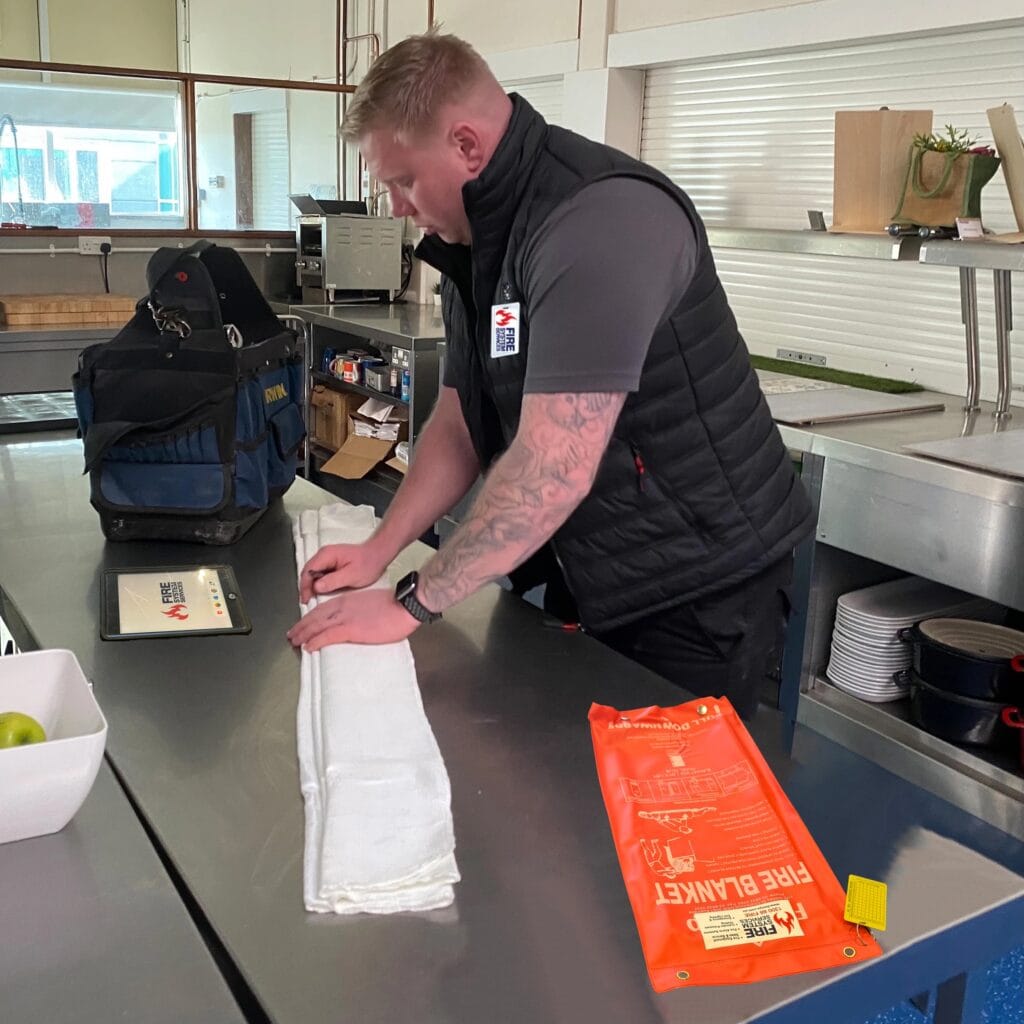
For commercial premises, a fire blanket is not a “set and forget” item. Its reliability is legally and functionally governed by AS 1851: Maintenance of fire protection systems and equipment. This standard dictates a rigorous inspection schedule designed to ensure the blanket will function perfectly in an emergency.
Compliance with AS 1851 is essential for liability, insurance, and regulatory accountability. The inspection requirements include:
1. Weekly Checks (Conducted by the Site Occupant/Staff)
Kitchen staff must perform and document quick visual checks, ensuring:
- Visibility and Access: The blanket container is clearly visible, easily accessible, and not obstructed by kitchen equipment, storage, or debris.
- Location: It is correctly mounted in its designated, highly visible spot, typically within close proximity to high-risk cooking zones (deep fryers, ranges).
- Damage Check: The casing or container is free from visible damage that could impede quick deployment.
2. Scheduled Maintenance (Professional Certification)
Certified fire technicians must perform detailed checks according to AS 1851 schedules (typically six-monthly or yearly, depending on the system type and local regulations). This involves:
- Deployment Test: While the blanket itself is not deployed (to avoid contamination), the technician checks the integrity of the quick-release mechanism.
- Physical Integrity: Inspecting the external container for signs of wear, degradation, or unauthorised tampering.
- Documentation: Updating the maintenance log and compliance tag, ensuring the service history is accurate and traceable.
Failure to adhere to the AS 1851 maintenance schedule jeopardises your ability to safely handle an emergency and may void insurance claims in the event of a fire.
Choosing The Appropriate Size Fire Blanket
Fire Blankets come in four sizes, 1.0m x 1.0m / 1.2m x 1.2m / 1.2m x 1.8m / 1.8m x 1.8m.
The fire blanket, when used to contain a fire in a pot or fry pan, should completely cover the cooking utensil and completely and totally wrapped it.
This allows no oxygen to access the fire for reignition.
1.0m x 1.0m for residential kitchens, small pots
1.2m x 1.2m for residential kitchens / BBQ
1.2m x 1.8m & 1.8m x 1.8m for commercial kitchens or where there may be a possibility that someone catches fire, termed “Human Torch”.
For Human Torch, as per AS2444 that the minimum size fire blanket will be 1.2m x 1.8m.
1.8m x 1.8m for commercial kitchens with deep oil fryers.
Do Fire Blankets Extinguish A Fire?
Fire Blankets generally do not extinguish a fire; they contain the fire and eliminate the oxygen, hence the fire burns out.
As soon as the fire blanket is removed, the fire may reignite.
Think about the Fire Triangle: “Tectrahegan” Heat, Oxygen, Fuel.
A correctly sized and type fire extinguisher must also be available for use in the kitchen.
Generally recommended CO2 Fire Extinguisher for stove top or oven fires, Wet Chemical Fire Extinguisher for deep oil-based frying fires.
Remember, NEVER TRY TO EXTINGUISH BURNING OILS / FAT FIRES WITH WATER.
Replacement After Use: Immediate Replacement is Mandatory

A crucial, often misunderstood, element of fire blanket safety is the single-use principle. If a fire blanket is used for any reason, even if the fire was small and instantly extinguished, it MUST be replaced immediately.
Why Fire Blankets are Single-Use:
- Material Integrity: The intense, direct heat from a fire, even a brief one, can weaken or compromise the molecular structure of the glass fibre fabric. While the blanket might look intact, its fire resistance capability is severely degraded, making it unreliable for a second use.
- Contamination Risk: In a commercial kitchen, the primary fuel is grease and oil. When the blanket is applied, it becomes saturated with these flammable residues. Restoring a grease-contaminated blanket is dangerous, as the stored grease itself becomes a new fuel source, potentially turning the “safety device” into a fire hazard.
- Packaging Damage: The quick-release tabs and folding of the blanket are precision-engineered. Once pulled, it is almost impossible for an untrained person to re-fold and repack the blanket to meet the required deployment speed and airtight sealing specifications.
If a fire occurs, the staff protocol must be clear: Use the blanket, secure the contaminated blanket in a safe disposal container, and contact your fire service provider for immediate replacement and site inspection. Do not attempt to clean or re-pack it.
Contact Us
The safety of your staff, the continuity of your business, and compliance with Australian fire safety standards all depend on the readiness of your fire protection equipment.
Do not wait for an incident to discover that your equipment is non-compliant or compromised. Ensure your commercial kitchen’s fire blankets are always accessible, correctly rated for the application, and professionally maintained to the strict requirements of AS 1851.
Act now to schedule your comprehensive fire safety audit and professional fire blanket servicing.
Email us today {info@firesys.com.au}
Protect your people, protect your investment, and secure your operation.
No Comments