
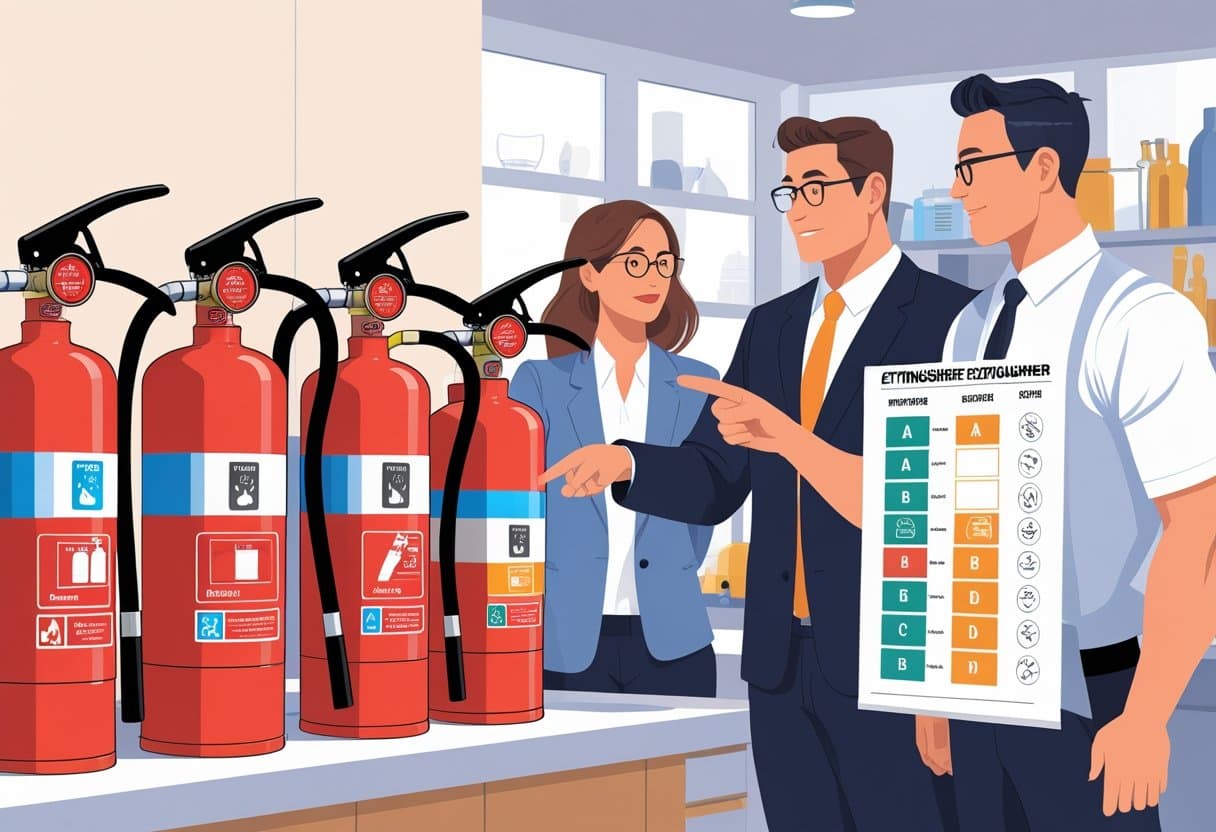
01 Nov How to Choose the Right Fire Extinguisher for Your Business
Selecting the right fire extinguisher requires understanding the specific fire hazards in your environment and matching them with the appropriate extinguisher type. Different fires need different suppression methods, and using the wrong extinguisher can make a fire worse or put people at risk.

The key to choosing the correct fire extinguisher lies in identifying the types of materials that could catch fire in your space and selecting an extinguisher rated for those specific fire classes.
Home kitchens need different protection than office spaces or industrial facilities, as each environment presents unique combustible materials and fire risks.
Beyond selecting the right type, proper sizing, placement, and regular maintenance ensure your fire extinguisher will work effectively when needed. Understanding legal requirements and training requirements also plays a role in making the right choice for your specific situation.
Key Takeaways
- Match your fire extinguisher type to the specific fire classes present in your environment based on combustible materials
- Consider proper sizing and strategic placement throughout your space for maximum coverage and accessibility
- Regular maintenance, inspections, and user training are essential for effective fire safety protection
Understanding Fire Extinguisher Types
Fire extinguishers are classified into distinct types based on the fires they combat and the suppression agents they contain. Each type corresponds to specific fire classes and uses different chemical agents to extinguish flames effectively.
Overview of Fire Extinguisher Classes

Fire extinguishers are categorized according to the types of fires they can safely and effectively extinguish. The classification system helps users select the appropriate extinguisher for their specific fire risks.
Class A extinguishers target ordinary combustible materials. These include wood, paper, fabric, cardboard, and most plastics. They work by cooling the burning material below its ignition temperature.
Class B extinguishers handle flammable liquid fires. These cover gasoline, oil, paint, propane, and other petroleum-based products. The extinguishing agent creates a barrier between the fuel and oxygen.
Class C extinguishers that can handle Flammable gases fires. LPG , Propiane Fires.
Class D extinguishers manage combustible metal fires. These specialized units handle magnesium, titanium, sodium, and lithium fires. Standard extinguishers can make metal fires worse.
Class E extinguishers focus on electrical fires. They target energized electrical equipment, wiring, circuit breakers, and appliances. These agents must be non-conductive to prevent electrical shock.
Cass F extinguishers focus on cooking oil fires. They specifically target high-temperature cooking oils and fats in commercial kitchens. The agent creates a foam blanket over the oil surface.
Common Fire Extinguisher Agents
Different suppression agents provide varying methods of fire control and suit different fire types. Each agent has specific advantages and limitations in fire suppression applications.
Water-based agents cool burning materials and create steam that displaces oxygen. They work effectively on Class A fires but conduct electricity and can spread flammable liquid fires.
Foam agents form a blanket over burning liquids to prevent vapor release. They combine water with surfactants to create a stable foam layer that suppresses Class A and B fires.
Dry chemical agents interrupt the chemical reaction of fire. Monoammonium phosphate works on Class A, B, and C fires, while sodium bicarbonate targets Class B and C fires specifically.
Carbon dioxide displaces oxygen around the fire source. This clean agent leaves no residue and works effectively on Class B and C fires without damaging sensitive equipment.
Clean agents include halogenated compounds that suppress fire through chemical interruption. They leave minimal residue and protect sensitive electronics and valuable materials from damage.
Labeling and Code Standards
Fire extinguisher labels provide critical information about proper usage, capacity, and fire class compatibility. Understanding these labels ensures correct selection and application during emergencies.
Fire class symbols appear as letters (A, B, C, D, E, F) often accompanied by pictographs. These symbols indicate which fire types the extinguisher can safely handle without making the situation worse.
Numerical ratings accompany Class A and B designations. Class A numbers indicate water equivalency in Litres, while Class B numbers show the approximate square footage of flammable liquid fire coverage.
Certification marks from recognized testing laboratories validate extinguisher performance. UL (Underwriters Laboratories) listings ensure the unit meets established safety and performance standards.
Maintenance tags display inspection dates, service records, and recharge information. These tags help track compliance with safety regulations and ensure extinguisher reliability.
Operating instructions include step-by-step usage procedures and safety warnings. Clear labeling helps users operate extinguishers correctly under high-stress emergency conditions.
No Comments