22 Dec Escape, Self-Contained and Airline BA – What Are The Differences?
Often, the term “SCBA” or “Breathing Apparatus” is used as a catch-all phrase. Whether it’s a vague entry requirement or a broad recommendation from a safety advisor, simply being told to “use BA” leaves a critical question unanswered: Which type is actually required?
Choosing the wrong equipment can be just as dangerous as using none at all. This guide clarifies the different categories of Breathing Apparatus to help you select the right protection for your environment.
Why Use Breathing Apparatus?
Breathing Apparatus (or “supplied air”) is essential when the ambient atmosphere is hazardous or life-threatening. Unlike standard filter masks or powered air systems—which merely purify the existing air—BA provides a clean, independent air source.
You should transition from filtration to BA when:
• The environment is Oxygen Deficient (less than 19.5%).
• Contaminant levels are too high for filters to manage.
• The specific toxins present cannot be filtered out by canisters.
• The atmosphere is IDLH (Immediately Dangerous to Life or Health).
There are 3 main types of Breathing Apparatus – EEBA Emergency Escape Sets , SCBA Self-Contained Breathing Apparatus and Airline Systems .
(EEBA) Emergency Escape Breathing Apparatus

Emergecy Escape Breathing Apparatus is designed exclusively for self-rescue. It is used to exit an environment that has become hazardous after entry.
A common application is in confined space entry where the atmosphere is currently safe, but a risk of sudden gas ingress or oxygen depletion remains. In these scenarios, the EBA is carried—not worn for breathing—allowing the user to quickly don the equipment and evacuate if conditions deteriorate.
Key Components and Features
An Escape Set typically features a compact compressed air cylinder (usually 2.0L or 3.0L) that provides a short duration of air—typically 10 to 15 minutes—to reach safety.
There are two primary styles of headgear available:
• Positive Pressure Face Masks: These provide a tight, secure seal. They are often preferred by regular BA users who are already fit-tested and comfortable with the feel of a full-face mask.
• Loose-Fitting Hoods: These are ideal for irregular users because they are much simpler to don under stress.
• Advantage: Unlike masks, hoods do not require a tight seal against the skin, making them the only viable option for users with facial hair or glasses.
Note: Emergency Escape BA is strictly for evacuation. It must never be used for entering a known hazardous zone or for performing work tasks.
(SCBA) Self-Contained Breathing Apparatus
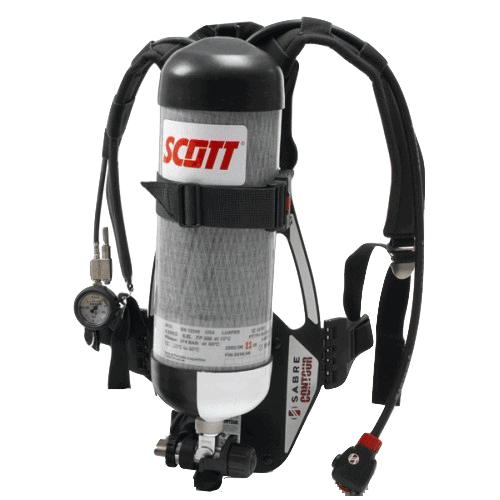
Self-Contained Breathing Apparatus—also known as Compressed Air Breathing Apparatus (CABA)—is the standard equipment for entering a known hazardous environment. While most famously associated with the Fire Service for navigating smoke and noxious gases, SCBA is essential for any industrial entry involving toxic gases, chemical asphyxiants, or oxygen-deficient atmospheres.
Core Components
An SCBA set is comprised of three primary elements:
1. Cylinder: A high-pressure vessel (typically 200–300 bar) containing compressed breathing air.
2. Back-plate & Pneumatics: A harness that secures the cylinder and regulates the air down to a manageable medium pressure (5–11 bar).
3. Face Mask: A positive-pressure mask that delivers the regulated air to the user.
Pros and Cons: Autonomy vs. Limitations
The primary advantage of SCBA is complete autonomy. Because the air source is carried on the back, the user can move freely without being tethered to a fixed point. However, this independence comes with specific trade-offs:
• Limited Duration: Air supply is finite. For example, a standard 9.0L cylinder at 200 bartypically provides only about 35 minutes of air, depending on the user’s exertion level.
• Bulk and Weight: The physical size of the cylinder increases the user’s profile, which can make navigating tight or cramped spaces difficult.
• Physical Strain: Carrying the weight of the set increases worker fatigue over time.
While various cylinder sizes (such as carbon fiber “lightweight” or high-capacity versions) can be used to improve duration or maneuverability, these fundamental limitations remain a factor in any risk assessment.
Airline Breathing Apparatus

Airline Breathing Apparatus provides a continuous air supply from a remote source, delivered to the user via a reinforced hose (airline). Because the air source is not carried on the back, the user is significantly less burdened by weight compared to a standard SCBA.
To ensure safety, the air source—whether from a mobile compressor or a fixed cylinder bank—must be tested to meet EN12021 air quality standards.
System Components and Safety
The air travels through the airline into a wearable airline harness, which then feeds the user’s face mask.
• The “Escape” Factor: Most professional airline systems incorporate a small emergency escape cylinder worn on the harness. If the main air supply fails or the hose is compromised, this cylinder provides enough air for the user to evacuate safely.
• Ideal Environments: These systems are best suited for tasks in localized areas where the work duration is expected to be long.
Practical Application: Tank Cleaning
A prime example of an airline system in use is tank cleaning. Because a large industrial tank may take days or weeks to clean, it is more efficient to have workers fed by a constant air line rather than stopping every 30 minutes to replace SCBA cylinders.
Air Supply Selection Guide
When planning your setup, it is vital to select an air source that matches your site’s infrastructure and the number of users involved:
Air Fills

The Breath of Life: Why Clean Air Fills are Non-Negotiable for SCBA
When a firefighter enters a smoke-filled building or a technician climbs into a confined chemical tank, their life depends entirely on the cylinder strapped to their back. While we often focus on the mechanics of the mask and the durability of the harness, the most critical component is invisible: the quality of the compressed air inside.
In the world of Self-Contained Breathing Apparatus (SCBA), “air is air” is a dangerous misconception. Here is why clean air fills are the foundation of site safety.
1. Preventing Internal Contamination
Standard atmospheric air contains moisture, oil vapors, and particulates. When air is compressed to 300 bar, these impurities are concentrated.
• Moisture: Can cause internal corrosion of the cylinder, weakening its structural integrity over time. Even worse, in cold environments, moisture can freeze the regulator, cutting off the air supply entirely.
• Oil Vapors: Often a byproduct of poorly maintained compressors, oil mist can cause lipid pneumonia if inhaled and poses a significant fire risk in high-pressure oxygen environments.
2. The Danger of Carbon Monoxide (CO)
The most lethal contaminant in a breathing air system is Carbon Monoxide. This can enter the system if a compressor intake is placed too close to engine exhaust or if the compressor itself is overheating. Because CO is odorless and tasteless, a user won’t know they are being poisoned until it is too late. High-quality fill stations utilize CO monitors and specialized catalysts to ensure the air remains pure.
3. Compliance with EN12021 Standards
In many regions, breathing air must meet strict legal standards, such as EN12021. This standard dictates the maximum allowable levels of:
• Oxygen levels (21\% \pm 1\%)
• Carbon Monoxide and Carbon Dioxide
• Oil mist and water vapor
• Odors and tastes
Failure to provide air that meets these standards doesn’t just risk equipment failure—it carries significant legal liability for the employer.
4. Equipment Longevity
SCBA sets are a major investment. Using “dirty” or “wet” air ruins the delicate seals and precision valves inside your demand valves and regulators. Clean air ensures that your equipment performs reliably every time the trigger is pulled, extending the time between expensive service overhauls.
The Bottom Line
Your SCBA is only as good as the air you put into it. Ensuring your fill station is regularly serviced, your filters are changed on schedule, and your air is periodically laboratory-tested isn’t just “best practice”—it is a life-saving necessity.
If you would like to know more about our air fills or Cylinder Hydro Tests see SCUBA & SCBA Air Fills
Contact Us
If you have any questions at all regarding the use of breathing apparatus, please do get in touch at info@firesys.com.au
Sorry, the comment form is closed at this time.